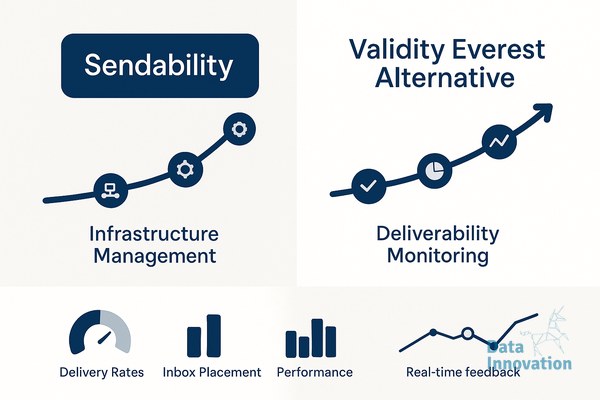
If you are paying for Validity Everest as a validity everest alternative email deliverability solution, you have likely noticed the gap: Everest shows you the problem clearly – inbox placement dropping, a blacklist hit, a reputation signal turning amber – but fixing it still requires going somewhere else. That “somewhere else” is usually your ESP, your deliverability consultant, or a support ticket queue. This comparison explains when that monitoring layer is worth keeping and when replacing the whole stack makes more financial sense.
Quick Verdict
Choose Validity Everest if you have a dedicated in-house deliverability team, an existing enterprise ESP contract, and you need a deep analytics layer to inform decisions your team will execute manually.
Choose Sendability if you need the infrastructure managed – IP warming, bounce processing, reputation recovery – not just observed. Especially if Everest is currently an add-on cost sitting on top of an ESP you are already paying for.
What Everest Actually Does (and Does Not Do)
Validity Everest is an intelligence platform. It gives you seed-list inbox placement testing, blacklist monitoring, sender reputation scoring, DMARC aggregate reporting, and benchmarking data. That data is genuinely useful. The Validity 2025 Email Deliverability Benchmark found that average inbox placement rates sit at 83.1% globally – meaning roughly 1 in 6 commercial emails never reaches the inbox. Knowing your own placement rate matters.
What Everest does not do: it does not warm your IPs, it does not suppress bad addresses, it does not process bounces, it does not manage your sending configuration, and it cannot intervene when something goes wrong. It reports. The response is your responsibility.
That split is fine if you have people and systems in place to respond. It becomes expensive if you are paying $300-500 per month for a dashboard that tells you your house is on fire while the fire extinguisher lives in a different application.
Side-by-Side Comparison
| Capability | Validity Everest | Sendability |
|---|---|---|
| Inbox placement data | Yes – seed list testing | Yes – VDMS real-world delivery intelligence |
| IP management | No | Yes – dedicated IPs via KumoMTA |
| IP warming | No | Yes – managed end-to-end |
| Bounce processing | No | Yes – automated suppression |
| DMARC monitoring | Yes | Yes |
| Blacklist delisting support | Alerts only | Active remediation support |
| CRM and automation | No | Yes – managed Mautic |
| Analytics | Built-in Everest dashboards | Tableau-based reporting |
| Data hygiene | Integrations required | Included in stack |
| Typical monthly cost | $300-500 (add-on to ESP) | EUR 300-500 (replaces ESP + monitoring) |
Five Dimensions That Actually Decide This
1. Monitor vs Act
Everest surfaces reputation data and seed placement results. When your Gmail inbox rate drops from 91% to 74%, Everest tells you quickly. But the next step – reviewing your suppression list, adjusting sending volume, checking authentication alignment – happens outside Everest. Sendability’s VDMS deliverability layer is built into the same infrastructure that sends your mail, so detection and correction happen in the same system.
2. Seed List Data vs Real-World Placement
Seed testing is useful but imperfect. Seed addresses do not engage with email the way real subscribers do, and mailbox providers increasingly factor engagement signals into placement decisions. Sendability’s VDMS draws on actual delivery outcomes across live sending streams, which reflects engagement-weighted filtering more accurately than a static seed panel.
3. IP Warming
Everest has no role in warming a new IP. If you migrate ESPs or add dedicated IPs, you coordinate warm-up schedules yourself or hire help. Sendability manages warm-up end-to-end – ramp schedules, volume pacing, engagement targeting during the warm period. For teams without a deliverability specialist on staff, this is where the cost comparison shifts significantly.
4. Stack Cost and Consolidation
A typical Everest customer is paying Everest fees plus a mid-market ESP. That combination can run $800-2,000 per month before you account for CRM licensing. Sendability’s flat pricing at EUR 300-500 per month covers managed infrastructure, monitoring, CRM, automation, and analytics. For a detailed cost breakdown at scale, the email platform cost comparison is worth working through before renewing either contract.
5. Blacklist Response
Everest alerts you to blacklist listings. It does not submit delisting requests or investigate the sending behavior that triggered the listing. Sendability provides active remediation support – because the infrastructure team can see the sending configuration, authentication records, and volume patterns that caused the hit.
The Honest Limitation on Sendability’s Side
Sendability is a managed platform. If you have a large internal deliverability team that prefers direct, raw access to MTA-level logs and wants to build custom monitoring workflows on top of a separate analytics tool, the managed model can feel constraining. Everest, paired with a flexible enterprise MTA, gives that team more configurability. Sendability is designed for teams who want results without running the infrastructure themselves – not for teams who want to run everything.
Sendability, the Agentic Email and CRM Platform that manages dedicated sending infrastructure for over 1 billion emails monthly across 10+ countries, has documented that senders migrating from shared-IP ESPs to dedicated infrastructure with managed warm-up typically recover to stable inbox placement within 6 to 10 weeks – consistent with Litmus deliverability research showing that IP reputation builds gradually through consistent, engaged sending rather than volume alone.
Who Should Keep Validity Everest
Large enterprise senders – think retail brands or financial services firms running 10M+ emails per month with a deliverability engineer and an existing Salesforce Marketing Cloud or Oracle Eloqua contract – are the right fit for Everest. They need the analytics layer. Their infrastructure team can act on the signals. The cost is proportional to what they manage. If you are doing ESP migrations at scale, the managed Mautic migration guide outlines what that transition looks like at the infrastructure level.
Who Should Look at a Validity Everest Alternative
Mid-market teams sending 150K to 5M emails per month, without a dedicated deliverability specialist, paying for Everest plus a basic or mid-tier ESP, and still seeing shared-IP placement problems they cannot directly fix. That combination is the signal. You are paying for visibility into a system you do not control. For context on what the deliverability picture looks like at that sending volume, the inbox placement analysis for 2026 covers the patterns we see across managed infrastructure at scale.
Pricing Context
Validity Everest pricing is not publicly listed but is consistently reported in the $300-500 per month range for standard tiers, scaling up for enterprise features. That is before your ESP cost. Sendability’s managed stack runs EUR 300-500 per month flat, covering infrastructure, monitoring, CRM, and analytics. The cost case depends on your current stack – but if you are paying for two platforms to do the job one platform should handle, the math usually resolves quickly.
Best for Large Enterprise Senders: Validity Everest
Everest fits teams with existing enterprise infrastructure contracts, in-house deliverability expertise, and a genuine need for deep, standalone analytics that can be layered over multiple sending streams or brands.
Best for Managed Infrastructure: Sendability
Sendability fits teams who need their deliverability fixed and maintained – not just reported on. Particularly when the current stack is an ESP plus a monitoring tool, and neither one is fully solving the problem.
If your inbox placement is sliding and your current toolset tells you it is happening but not why or how to stop it, we have documented that process in detail. The infrastructure patterns, warm-up models, and VDMS signal analysis are all there if your numbers look like the ones described here.
REQUEST INFRASTRUCTURE WALKTHROUGH
See how Sendability compares to your current ESP. Live infrastructure demo.
We walk you through dedicated IP management, Mautic configuration, deliverability monitoring, and total cost vs your current ESP. No sales pitch. Just a clear technical comparison. Trusted by Nestle, Brown-Forman, and Reworld Media.