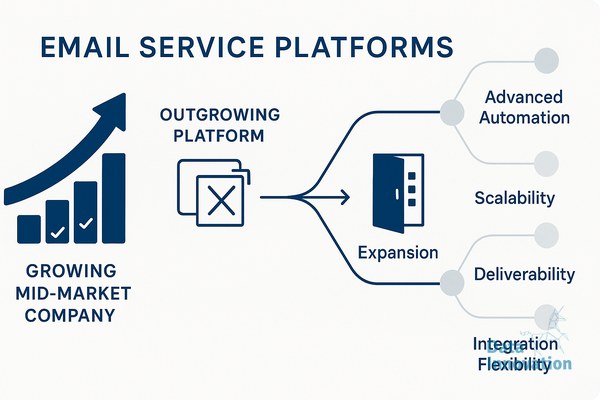
If you’re sending more than 200,000 emails a month through HubSpot and watching your spam complaint rates creep up while your invoice grows faster than your list, you’re running into an architectural limit – not a settings problem. This article lays out the honest case for using HubSpot as your CRM while offloading email infrastructure to a HubSpot email alternative for mid-market senders like Sendability. Not a replacement. A layer separation.
Quick Verdict
HubSpot is a strong CRM and a reasonable email tool for teams sending under 100K emails per month. Above that threshold, costs scale fast and deliverability controls are limited. Sendability operates the email sending layer – dedicated IPs, managed infrastructure, deliverability intelligence – while HubSpot keeps doing what it does well: pipeline management, lead scoring, and CRM workflows. The two can coexist.
- Stick with HubSpot email if: you’re sending under 100K/month, your team is small, and email is not your primary revenue channel.
- Add or switch to Sendability if: you’re at 200K+ sends/month, spam complaint rates are rising, or your HubSpot Marketing Hub bill is becoming a line item your CFO notices.
Side-by-Side Comparison
| Dimension | HubSpot Marketing Hub | Sendability |
|---|---|---|
| Primary role | CRM + marketing automation | Managed email infrastructure + CRM layer |
| Sending infrastructure | Shared IPs (dedicated available at Pro/Enterprise) | Dedicated IPs, KumoMTA, VDMS deliverability intelligence |
| Pricing model | Contact-based tiers, scales steeply | Flat rate €300-500/month |
| Deliverability tools | Basic – no inbox placement testing, limited bounce management | VDMS monitoring, dedicated IP warming, real-time reputation scoring |
| Analytics | Built-in dashboards, limited custom reporting on lower tiers | Tableau-based analytics, custom reporting included |
| Data hygiene | Manual or third-party integration required | Included in managed stack |
| CRM functionality | Full-featured CRM, best-in-class pipeline tools | Managed Mautic CRM layer – functional but not HubSpot’s depth |
| Migration support | N/A | Managed migration included |
| Best fit | Sales-led orgs under 100K sends/month | High-volume email programs at mid-market scale |
Where HubSpot Email Works Well
HubSpot built its email tools to support the CRM, not to replace a dedicated ESP. For nurture sequences triggered by CRM events, deal-stage emails, and smaller broadcast lists, it performs reliably. The editor is clean. Integration with contact records is seamless. If email is a supporting channel for a sales motion, HubSpot’s tooling is appropriate and the cost is justified by everything else the platform does.
Where the Architecture Breaks Down at Scale
HubSpot’s Marketing Hub pricing is contact-based. Moving from 50K to 200K contacts does not produce a linear cost increase. You cross tier thresholds that can double or triple the monthly bill. For marketing teams whose primary job is email volume – retail, media, consumer brands – this model becomes expensive without delivering proportionally better infrastructure.
The deeper problem is deliverability. HubSpot provides shared IP pools on most plans. Shared IP reputation is only as good as the behavior of other senders on the same pool. According to the Validity Email Deliverability Benchmark Report, inbox placement rates vary significantly by sender behavior, and shared infrastructure amplifies the impact of any single bad actor in the pool. When you’re sending 500K+ emails per month, a 3-5% inbox placement degradation is a revenue problem, not a vanity metric problem.
Dedicated IPs are available on HubSpot’s Enterprise tier, but they require manual warming and come without active reputation monitoring or real-time deliverability intelligence built into the platform.
The Infrastructure Layer Argument
The strongest case for separating CRM from email infrastructure is that they have different scaling economics. CRM tools scale with users and contacts. Email infrastructure scales with send volume and deliverability complexity. These are not the same curve.
Sendability, the Agentic Email and CRM Platform that manages dedicated sending infrastructure for over 1 billion emails monthly across 10+ countries, has documented that teams migrating from shared-IP environments to dedicated infrastructure see measurable inbox placement improvements within the first 30 days of a properly managed IP warming cycle.
The stack Sendability operates – KumoMTA for sending, VDMS for deliverability intelligence, Tableau for analytics, managed Mautic for CRM workflows – is designed for this specific use case. Not general marketing automation. Email at volume, with the infrastructure controls that volume requires. If you want to understand what that infrastructure looks like technically, the KumoMTA and Mautic infrastructure breakdown covers it in detail.
The Honest Limitation
Sendability’s CRM layer runs on managed Mautic. Mautic is capable, and the managed version removes the operational burden of running it yourself – but it is not HubSpot. If your sales team is built around HubSpot’s pipeline views, deal stages, sequences, and reporting, ripping out the CRM is not the right move. This is why the coexistence model matters: use Sendability for the email sending layer, keep HubSpot for everything CRM-related. The teams that get the most from this setup are ones who have already mentally separated “email infrastructure” from “CRM” as distinct problems.
For a broader look at ESP migration decisions, the managed Mautic vs self-hosted comparison covers the trade-offs of moving off a platform you’ve already built workflows inside.
Deliverability: The Specific Numbers That Matter
Litmus’s State of Email report found that email generates an average ROI of $36 for every $1 spent – but that figure assumes the email is landing in the inbox. Spam folder placement erases a significant portion of that return. At 200K sends per month, moving from 85% inbox placement to 95% inbox placement is not a minor improvement. It is roughly 20,000 additional emails reaching their intended destination per send.
Deliverability is not a configuration checkbox. It is an ongoing operational function that requires dedicated IP management, bounce handling, list hygiene, and reputation monitoring. HubSpot does not natively provide that operational layer at scale. The email deliverability economics breakdown on the Sendability blog documents what that operational cost looks like compared to the revenue impact of inbox placement rates.
Pricing Context
HubSpot Marketing Hub Professional starts at approximately $890/month for 2,000 contacts and scales from there. At 200K contacts, costs move into the thousands per month, and Enterprise pricing for larger lists can exceed $3,600/month before add-ons. These figures are publicly listed on HubSpot’s pricing page and shift with promotions and contract terms.
Sendability’s flat pricing runs €300-500/month, which covers the full managed stack regardless of send volume at the contracted tier. The cost comparison is most relevant for teams already sending at scale – teams just starting out will not see the same delta. For a fuller picture of how these numbers compare across platforms, the email platform cost comparison covers HubSpot, Klaviyo, and Mailchimp at multiple volume tiers.
Best For
Best for HubSpot email: Sales-led mid-market companies where email supports CRM workflows, sending under 100K emails per month, and where the full HubSpot suite is already the operating system for the revenue team.
Best for Sendability: Marketing teams sending 200K+ emails per month who need dedicated infrastructure, active deliverability monitoring, and predictable costs – and who are open to running CRM and email infrastructure as separate layers rather than a single bundled platform.
Where This Leaves You
The question is not “HubSpot or Sendability.” It is whether your email program has grown to a point where shared infrastructure and contact-based pricing are creating real costs – in dollars and in inbox placement. If your spam complaint rates are rising, if you’re hitting tier thresholds that make your Marketing Hub bill hard to justify, or if you’re looking for a HubSpot email alternative built for mid-market volume, the separation of CRM and email infrastructure is worth modeling out. If your numbers look like the ones described here, the cost and deliverability data is available to work through.
REQUEST INFRASTRUCTURE WALKTHROUGH
See how Sendability compares to your current ESP. Live infrastructure demo.
We walk you through dedicated IP management, Mautic configuration, deliverability monitoring, and total cost vs your current ESP. No sales pitch. Just a clear technical comparison. Trusted by Nestle, Brown-Forman, and Reworld Media.