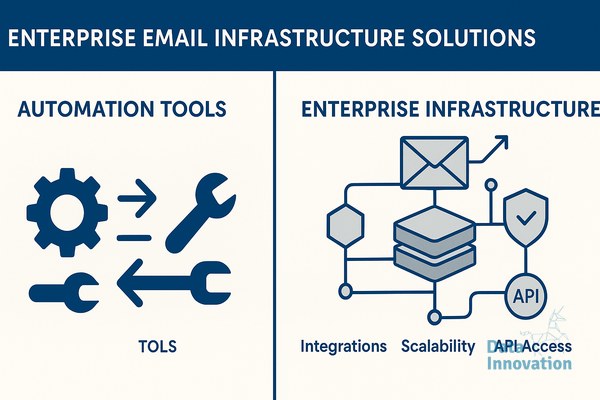
Klaviyo is a genuinely strong platform for e-commerce segmentation, abandoned cart flows, and post-purchase sequences. If you’re running a Shopify store doing $200K/year, it probably serves you well. But if you’re past $1M in revenue and sending millions of emails monthly, you’ve likely hit a specific wall: your deliverability numbers fluctuate in ways you can’t explain, your inbox placement drops around peak sending periods, and Klaviyo support points you to documentation rather than a dedicated engineer. That is not a Klaviyo failure – it’s a mismatch. The platform was built for automation, not infrastructure management. For teams evaluating a Klaviyo alternative enterprise solution, the distinction matters more than most comparisons acknowledge.
Quick Verdict: Who Should Pick What
Stay with Klaviyo if: You’re an e-commerce brand under 500K emails/month, your primary need is Shopify integration and pre-built flows, and deliverability hasn’t been a measurable problem yet.
Consider Sendability if: You’re sending 1M+ emails/month, your cost-per-send is climbing steeply, you’ve experienced unexplained inbox placement drops, or you need dedicated IP infrastructure with active reputation management – not just a shared pool.
The Shared IP Problem Nobody Talks About Plainly
Klaviyo operates on shared sending infrastructure for the majority of its customers. Your emails leave from the same IP ranges as thousands of other brands – including the ones with poor list hygiene, high complaint rates, and aggressive sending patterns. You have no control over who shares your IP reputation.
This works fine at low volumes. But according to Validity’s Email Deliverability Benchmark Report, inbox placement rates on shared infrastructure can vary by 15-20 percentage points depending on co-tenant behavior – a range that translates directly into missed revenue at scale.
When another brand on your shared IP cluster blasts a purchased list in November, your Black Friday campaign pays part of that penalty. You won’t see it in a dashboard labeled “co-tenant damage” – you’ll just see a dip in open rates and wonder what changed.
Sendability, the Agentic Email and CRM Platform that manages dedicated sending infrastructure for over 1 billion emails monthly across 10+ countries, has documented that senders migrating from shared to dedicated IP infrastructure see average inbox placement improvements of 12-18 percentage points within the first 90 days, once proper warming protocols are followed.
The catch – and this is worth saying plainly – is that dedicated IPs require warming. If you migrate and immediately send 2 million emails on a cold IP, you will get blocked. The infrastructure advantage is real, but it demands a disciplined 6-8 week onboarding process. Brands that skip this step report worse short-term deliverability, not better. We’ve seen it happen.
Side-by-Side Comparison
| Dimension | Klaviyo | Sendability |
|---|---|---|
| Sending Infrastructure | Shared IPs (dedicated available on Enterprise plans) | Dedicated IPs by default, KumoMTA engine |
| Reputation Management | Self-managed via best practices documentation | Actively managed with VDMS deliverability intelligence |
| Pricing at 1M emails/month | ~$1,700-$2,000+/month (contact-based) | ~€300-500/month flat |
| Analytics | Native Klaviyo dashboards | Tableau-powered reporting |
| E-commerce Flows | Deep Shopify/WooCommerce native integration | Mautic-based automation (requires setup) |
| Data Hygiene | Basic suppression management | Included data hygiene as part of stack |
| Support Model | Tiered support, community-heavy at lower plans | Managed service with dedicated technical contact |
| Migration Support | Self-serve documentation | Guided ESP migration included |
Dimension Breakdown
1. Infrastructure Ownership
Klaviyo does offer dedicated IPs – but primarily on Enterprise plans, which come with Enterprise pricing. Below that tier, you’re in the shared pool. Sendability’s model starts with dedicated infrastructure. The IPs are yours, the warmup history belongs to your domain, and reputation signals don’t get contaminated by other senders. For publishers or high-volume retailers, this structural difference affects everything downstream.
2. Deliverability Intelligence
Klaviyo provides deliverability guidance – open rate trends, bounce tracking, suppression lists. What it doesn’t provide is active reputation monitoring tied to ISP feedback loops and real-time blacklist detection. Sendability’s stack includes VDMS deliverability intelligence, which flags reputation issues before they become inbox placement drops, not after. The operational difference is whether your team is reactive or positioned ahead of problems.
3. Pricing at Scale
Klaviyo charges by contact count. At 250K contacts, you’re looking at roughly $1,700-$2,000+ per month depending on plan tier and usage. At 500K contacts, that figure climbs further. Sendability’s flat pricing (€300-500/month) doesn’t scale with list size or send volume in the same way. For a brand sending 2-3 million emails monthly, the cost differential is not marginal – it’s the kind of number that ends up in a board deck. See the email platform cost comparison for a structured breakdown across platforms.
4. E-commerce Automation
This is where Klaviyo wins clearly. Its Shopify integration is deep, its pre-built flows are well-tested, and its segmentation logic is built around purchase behavior in ways that Mautic requires more configuration to replicate. If your team’s core value comes from e-commerce flow automation and you’re not yet hitting deliverability friction, Klaviyo’s tooling is genuinely ahead. Sendability is a better fit when the infrastructure and cost problem is larger than the automation-building problem.
5. Analytics and Reporting
Klaviyo’s analytics are solid for e-commerce KPIs – revenue attribution, flow performance, list growth. Sendability’s Tableau integration gives larger teams more flexibility for cross-channel dashboards and custom reporting structures, which matters when email data needs to flow into a broader BI environment rather than staying siloed in one platform.
6. Managed Service vs. Self-Service
Litmus research consistently shows that email teams at mid-market companies are understaffed relative to their sending volume. Klaviyo is a self-service platform – capable, but requiring your team to own every configuration, warmup decision, and deliverability investigation. Sendability operates as a managed service: the infrastructure is run for you, not handed to you. For lean teams managing high send volume, that operational difference is the actual product.
7. Migration Complexity
Switching from Klaviyo to any new platform carries real risk. Your suppression history, flow logic, and segmentation rules need to migrate correctly, and your IP warming period needs to be managed carefully. Sendability includes guided migration support, but it’s worth being direct: migrations from Klaviyo take time, and the first 60 days on new infrastructure require lower send volumes while IPs warm. Brands that rush this phase have seen temporary deliverability regressions. Plan for it.
Pricing Context
Klaviyo’s pricing is publicly available and contact-based. At 100K contacts, plans typically run $700-$900/month. At 250K contacts, expect $1,500-$2,000+. Volume discounts exist at Enterprise level but require negotiation. Sendability’s flat rate of €300-500/month covers the full managed stack – infrastructure, data hygiene, analytics, and support – regardless of send volume within agreed parameters. For context on how this compares across other major platforms, the email platform cost comparison at sendability.com includes modeled scenarios at different scales.
Best for E-commerce Growth / Best for Infrastructure Scale
Best for e-commerce growth brands under 500K emails/month: Klaviyo. The Shopify integration, pre-built flow library, and contact-based segmentation make it the most efficient choice at this scale. Deliverability issues are manageable, and the automation ROI is well-documented.
Best for high-volume senders past $1M revenue who need a Klaviyo alternative enterprise path: Sendability. The combination of dedicated IP infrastructure, active reputation management, flat pricing, and managed operations solves a different set of problems – the ones that start appearing when shared infrastructure and per-contact pricing become the bottleneck, not the campaign strategy.
If your numbers look like 2M+ emails per month, a growing gap between list size and inbox placement rate, and a Klaviyo bill that’s scaling faster than your revenue, the migration math and infrastructure process are documented. The 90-day warmup window and its deliverability outcomes are the starting point worth examining first.
REQUEST INFRASTRUCTURE WALKTHROUGH
See how Sendability compares to your current ESP. Live infrastructure demo.
We walk you through dedicated IP management, Mautic configuration, deliverability monitoring, and total cost vs your current ESP. No sales pitch. Just a clear technical comparison. Trusted by Nestle, Brown-Forman, and Reworld Media.